
Bi-Directional Suctioning for Endotracheal Tube Clearance
Why Do We Suction Only During Catheter Withdrawal?
Closed suction catheters allow an intubated patient to be suctioned without disconnecting the patient from the ventilator. Closed suction catheters were invented for adult ventilator patients by Darrel Palmer at Ballard Medical in 1984.
This was an important advancement. Keeping the ventilator connected helps to preserve ventilatory support and PEEP during airway clearance. It is cleaner and more convenient than open suction, and is also thought to reduce ventilator-associated pneumonia (VAP), although the research on reducing VAP is mixed.
The conventional closed suction catheter incorporates a normally closed thumb-control valve. The valve keeps suction off while the catheter is connected to wall suction and prevents suction from removing air from the breathing circuit. The thumb valve has a “lock” that prevents accidental activation.
The procedure that remains common today is:
- Insert the catheter into the endotracheal tube (ETT) with suction off.
- Advance the catheter to the desired depth with suction off.
- Activate the thumb valve.
- Apply suction while withdrawing the catheter.
There was a practical reason for developing this technique. Ventilators in the 1980s lacked the ability to compensate for the flow out of the circuit when suction was opened. Applying suction before catheter insertion would interfere with ventilation and trigger ventilator alarms.
When neonatal-size closed suction catheters became available, the same suction-on-withdrawal technique was adopted,but ventilators have changed considerably since then.
Modern Ventilators Change the Equation
Today’s neonatal and pediatric ventilators can provide continuous flow, CPAP, demand flow, and/or leak compensation, depending on the ventilator and mode.
This raises an important opportunity:
If ventilatory pressure can be maintained while suction is being applied, is there still a reason to wait until catheter withdrawal to begin clearing secretions?
Our research model shows that, particularly with neonatal ETTs, there is an advantage to clearing secretions while the catheter is being inserted as well as while it is being withdrawn.
We call this Bi-Directional Suctioning.
The Smaller the ETT, The Larger the Problem
The relationship between the suction catheter and the internal diameter of the ETT becomes increasingly important as ETT size decreases.
In a neonatal ETT, there is very little space around the suction catheter. Add secretions, and the pathway available for ventilator flow around the catheter becomes severely restricted.
With conventional suctioning, the catheter is advanced through those secretions with suction off.
The catheter may therefore push secretions ahead of it while simultaneously blocking the ETT lumen.
When suction is finally activated, the ventilator’s pathway to the distal end of the catheter may be restricted or blocked completely. In our bench model, this condition was associated with substantial negative-pressure excursions beyond the ETT.
Why Does Bi-Directional Suctioning Make a Difference?
With the Bi-Directional method, suction is active while the catheter is being inserted. With the assistance of modern ventilators, closed suction can now remove secretions as the catheter advances.
Bi-Directional suctioning clears a pathway through the ETT and allows the ventilator’s PEEP or CPAP to communicate to the distal end of the catheter where its withdrawing air and secretions.
The catheter continues to clear secretions during withdrawal. In other words: Clear secretions going in. Clear secretions coming out.
Bi-Di Cath™
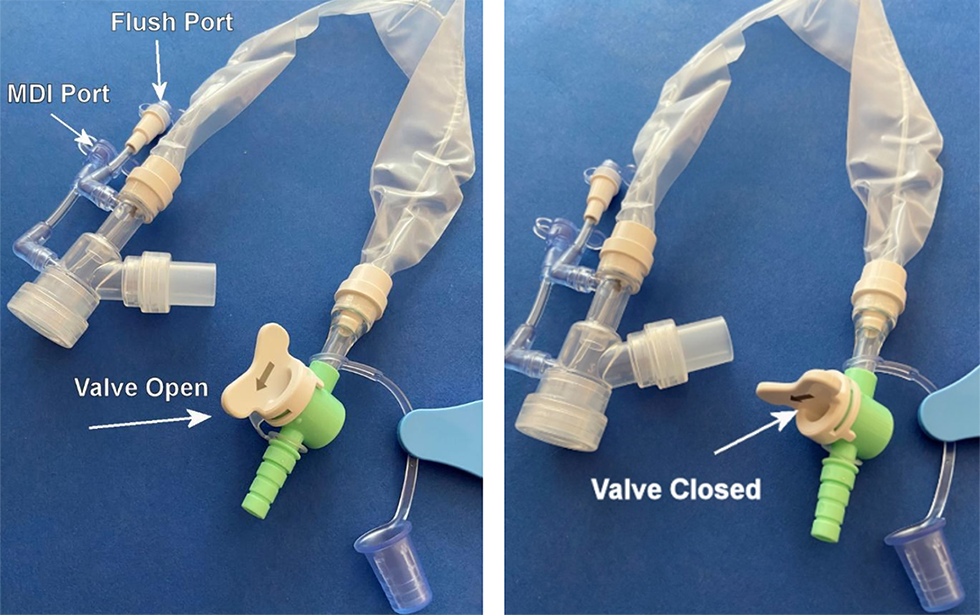
The DRW Medical Bi-Directional Closed Suction Catheter (Bi-Di Cath) is specifically designed to facilitate Bi-Directional Suctioning.
Bi-Di Cath uses a manual stopcock-style suction valve instead of the conventional spring-loaded thumb-control valve. Suction is activated by opening the valve, leaving both hands available to control insertion and withdrawal of the catheter. This makes it easier to clear secretions during both phases of the procedure.
Bi-Di Cath is available in:
- 5 Fr
- 6 Fr
- 7 Fr
- 8 Fr